

Thank you for Subscribing to Hospitality Business Review Weekly Brief
Hospitality Business Review: Specials Magazine
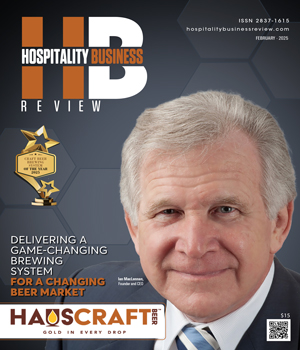
MacLennan’s journey to transform brewing began with a simple yet innovative product; a device for the small batch home brewer called “The Beer Machine”. It was an instant success, inspiring a community of amateur brewers and sparking an idea that would grow into something much larger. “It started as a hobbyist product just like many of todays most popular craft breweries,” MacLennan says. “But as I engaged with our customers, I saw a bigger opportunity. People wanted the quality and control of home brewing, but they also wanted the consistency and scalability to serve their friends, customers, or communities. That realization became the foundation for HausCraftBeer.” What followed was a decade of refinement and collaboration including with renouned professor emeritus of brewing science at UC Davis, Dr. Michael Lewis, often referred to as the father of the craft beer movement. Dr. Lewis helped guide the company with the science of brewing to take this from a clever concept to a game-changing solution. The HausCraft System: Small Space - Big Beautiful Impact At the heart of HausCraftBeer’s innovation is its patented brewing system, which combines a compact design housed in copper and brass with cutting-edge technology. Traditional breweries require large spaces, extensive plumbing, and costly equipment. But the self contained HausCraft system fits into a space as small as 10 by 20 feet. “It’s truly a marvel of engineering,” says Collett. “Think about it. Most breweries need thousands of square feet and significant capital investment to get started. Our system allows businesses to set up a fully functioning brewery in what’s essentially the size of a home office.” Here’s what a senior personnel of a large restaurant down in Orange Beach, Alabama has to say about the system: “The HausCraftBeer System has been a game-changer for our operations. We inherited it when taking over a restaurant, and after setup and training, it became a seamless part of our workflow. Its simplicity— especially the brew-in-the-bag system— cuts cleaning and setup time, while the quality of malts ensures consistent results. Even during high-demand months with snowbirds flocking in, the system enables us to craft great-tasting beers at low cost, enhancing profit margins while offering unbeatable value. It’s reliable, adaptable, and instrumental in keeping our happy hour crowds coming back for more.”
Travel And Tourism Marketing
Today’s travelers seek more than just attractive destinations—they want experiences that align with their passions and values. As the tourism industry becomes increasingly competitive, businesses need more than picturesque visuals to capture attention. They need stories that build emotional connections, ignite wanderlust, and drive action. In an overcrowded market, the key to success lies in crafting tailored narratives that resonate with the right audience. Gray Media, a leader in destination marketing, is addressing this need head-on. The company helps destinations craft compelling campaigns that inspire action. “We blend creative storytelling, advanced technology, and precise audience targeting to help our clients drive engagement, boost visibility, and achieve measurable growth,” says Jennifer Casey, Director of Strategic Partnerships. Tailored Strategies for Targeted Growth With 197 television stations spanning 113 markets, the company is deeply embedded in local communiti.

Revolutionizing Hospitality With Seamless, Smart Experiences

As innovative technologies continue to evolve and impact nearly every aspect of people’s lives, so too have they impacted the way people travel. In today’s interconnected world, travelers are becoming increasingly demanding in how they want to communicate with hotels. For them, it is no longer about only booking a room to stay; it’s more about the entire staying experience, right from the moment they reach out to the hotel until they physically check-out from the hotel. This shift in consumer behavior is, in turn, pushing hoteliers to respond to such demands and craft more interactive experiences by integrating smart technology into hotel rooms and services. Many hospitality organizations are riding on this digital wave to bring a more seamless and contactless guest experience and improve their overall business outcome, even amid tumultuous times. On that note, the recent COVID-19 pandemic can be regarded as one of the critical milestones in the hospitality industry, keeping physical touchpoints at a bare minimum while improving the guest experience. But while these shifts seemed easier for large hotel businesses, it was comparably much harder for small and medium-sized hoteliers to pivot their operations digitally. Enter INTELITY. With over 15 years of experience in hospitality tech, INTELITY focuses on developing solutions around the digital traveler’s journey that can help hotels craft a seamless and contactless guest experience without huge implementation costs. A trailblazer in hospitality tech, INTELITY has developed many first-of-its-kind hospitality technologies—including request solutions, mobile key capability, and out-of-the-box guest experience apps. “In a way, we can be regarded as the inventors of the concept’ guest experience,’” states Robert Stevenson, CEO of INTELITY. “Our mission, from the start, has always been to provide hoteliers as well as cruise and casino owners with the most advanced guest experience platform available.” Under the Hood of INTELITY’s Guest Experience Platform
CXO INSIGHTS

Consumer-Direct Business Strategy
Danny Rose, SVP, E-Commerce

Elevating Craft Beer Marketing With Strategy and Passion
Talia Shapiro, Trade Marketing Manager, Craft West - Elysian Brewing, Golden Road Brewing, Four Peaks Brewing, Anheuser-Busch

Exploring the Current Trends in Hospitality Sales Training
Kimi Holloway, Director of National Corporate Sales, Strategy and Training, US, City Experiences

Leading with Empathy
Jennifer McClain, Senior Director Human Resources & Benefits, The Hertz Corporation

Role of Preventative Programs like EMP to Ensure Food Safety and Quality
Johanna Ramirez, Director of Microbiology & Food Safety, The Coca-Cola Company

IN FOCUS

EDITORIAL
The Rise of Experiential Hospitality
In an era where consumers crave authenticity and immersive experiences, two industries have found a powerful synergy: craft beer brewing systems and travel and tourism marketing services. While seemingly distinct, these sectors are increasingly intertwined, with breweries serving as travel destinations and tourism marketing amplifying the reach of craft beer experiences worldwide.
Craft beer brewing has evolved beyond the production of quality beer; it is now an integral part of local culture and tourism. Breweries are no longer just production hubs but have transformed into must-visit destinations, offering taproom tastings, brewery tours, and exclusive behind-the-scenes experiences. To cater to this growing demand, modern brewing systems are becoming more compact, efficient, and sustainable, allowing small breweries to thrive in urban centers, rural getaways, and even mobile settings such as beer buses and pop-up tasting events.
Brewing technology advancements, such as automated microbrewing systems and sustainable brewing methods, have enabled brewers to produce high-quality, small-batch beer with precision. These innovations support the increasing number of brewery owners looking to integrate their craft into travel itineraries, attracting tourists eager for unique, locally inspired flavors.
Cities like Portland, Oregon, and Brussels, Belgium, have successfully branded themselves as beer tourism hubs through strategic campaigns that highlight their brewing heritage. Destination marketing organizations (DMOs) now partner with breweries to promote craft beer trails, festivals, and exclusive events, boosting both tourism revenue and local brewery sales.
Both industries are increasingly prioritizing sustainability. Breweries are implementing eco-friendly brewing practices such as water conservation, renewable energy use, and waste reduction. In parallel, travel marketers are emphasizing eco-conscious tourism, encouraging travelers to support sustainable breweries that contribute to local economies while minimizing environmental impact. This alignment resonates with eco-conscious consumers seeking guilt-free indulgences and authentic regional flavors.
For breweries, investing in innovative brewing systems and aligning with tourism marketing strategies will ensure long-term success. For travel marketers, promoting beer tourism as a cultural and sensory journey will captivate audiences worldwide. Together, these industries will continue to shape the evolving landscape of experiential travel and craft beer appreciation.
