
Thank you for Subscribing to Hospitality Business Review Weekly Brief


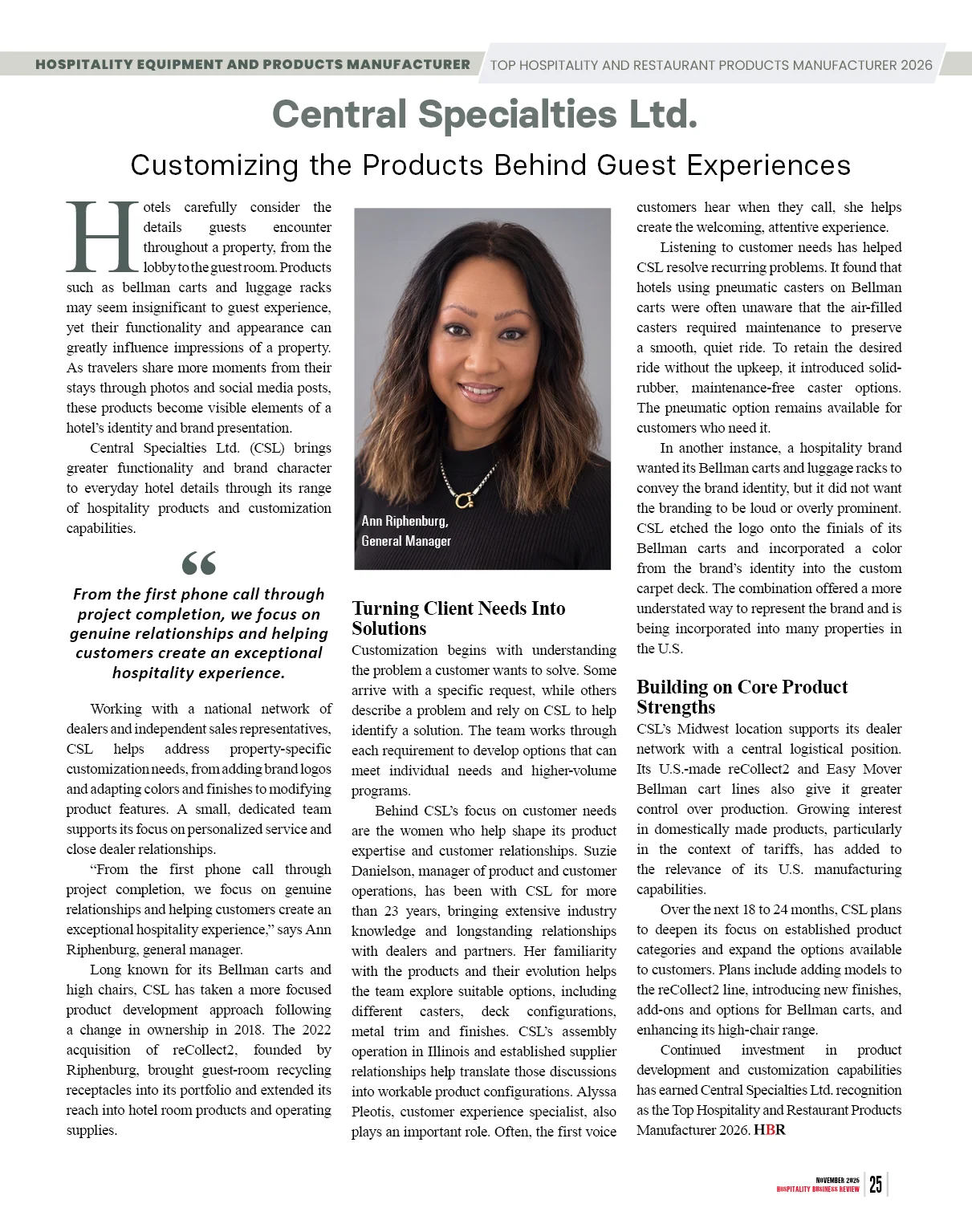
 Ann Riphenburg, General Manager
Hotels carefully consider the details guests encounter throughout a property, from the lobby to the guest room. Products such as bellman carts and luggage racks may seem insignificant to guest experience, yet their functionality and appearance can greatly influence impressions of a property. As travelers share more moments from their stays through photos and social media posts, these products become visible elements of a hotel’s identity and brand presentation.
Central Specialties Ltd. (CSL) brings greater functionality and brand character to everyday hotel details through its range of hospitality products and customization capabilities.
Working with a national network of dealers and independent sales representatives, CSL helps address property-specific customization needs, from adding brand logos and adapting colors and finishes to modifying product features. A small, dedicated team supports its focus on personalized service and close dealer relationships.
“From the first phone call through project completion, we focus on genuine relationships and helping customers create an exceptional hospitality experience,” says Ann Riphenburg, general manager.
Long known for its Bellman carts and high chairs, CSL has taken a more focused product development approach following a change in ownership in 2018. The 2022 acquisition of reCollect2, founded by Riphenburg, brought guest-room recycling receptacles into its portfolio and extended its reach into hotel room products and operating supplies.
Turning Client Needs Into Solutions
Customization begins with understanding the problem a customer wants to solve. Some arrive with a specific request, while others describe a problem and rely on CSL to help identify a solution. The team works through each requirement to develop options that can meet individual needs and higher-volume programs.
Behind CSL’s focus on customer needs are the women who help shape its product expertise and customer relationships. Suzie Danielson, manager of product and customer operations, has been with CSL for more than 23 years, bringing extensive industry knowledge and longstanding relationships with dealers and partners. Her familiarity with the products and their evolution helps the team explore suitable options, including different casters, deck configurations, metal trim and finishes. CSL’s assembly operation in Illinois and established supplier relationships help translate those discussions into workable product configurations. Alyssa Pleotis, customer experience specialist, also plays an important role. Often, the first voice customers hear when they call, she helps create the welcoming, attentive experience.
Listening to customer needs has helped CSL resolve recurring problems. It found that hotels using pneumatic casters on Bellman carts were often unaware that the air-filled casters required maintenance to preserve a smooth, quiet ride. To retain the desired ride without the upkeep, it introduced solid-rubber, maintenance-free caster options. The pneumatic option remains available for customers who need it.
-
From the first phone call through project completion, we focus on genuine relationships and helping customers create an exceptional hospitality experience.
In another instance, a hospitality brand wanted its Bellman carts and luggage racks to convey the brand identity, but it did not want the branding to be loud or overly prominent. CSL etched the logo onto the finials of its Bellman carts and incorporated a color from the brand’s identity into the custom carpet deck. The combination offered a more understated way to represent the brand and is being incorporated into many properties in the U.S.
Building on Core Product Strengths
CSL’s Midwest location supports its dealer network with a central logistical position. Its U.S.-made reCollect2 and Easy Mover Bellman cart lines also give it greater control over production. Growing interest in domestically made products, particularly in the context of tariffs, has added to the relevance of its U.S. manufacturing capabilities.
Over the next 18 to 24 months, CSL plans to deepen its focus on established product categories and expand the options available to customers. Plans include adding models to the reCollect2 line, introducing new finishes, add-ons and options for Bellman carts, and enhancing its high-chair range.
Continued investment in product development and customization capabilities has earned Central Specialties Ltd. recognition as the Top Hospitality and Restaurant Products Manufacturer 2026.
When Hospitality Equipment Must Serve More than Function
Hospitality equipment procurement becomes difficult when a product must satisfy more than a single functional brief. A cart or receptacle may sit directly in the guest experience, yet purchasing teams also have to weigh maintenance burden, brand consistency, procurement timing and long-term usability. Small design choices can create recurring property-level friction, especially when a standard configuration does not match how the item will actually be handled. Equipment can also remain highly visible in lobbies and guest rooms, making appearance part of the purchasing decision rather than an afterthought. The most useful comparison, therefore, starts with how closely a manufacturer can translate property requirements into a workable specification rather than simply offering a broad catalog.
Customization matters most when it changes how the product functions or appears in a real property setting. Branding should not be treated as logo placement alone. Buyers may need specific finishes, colors, deck materials and subtle brand treatments that fit an existing environment without making the equipment look overstated. A supplier should also be able to determine whether a requested modification can be repeated consistently across dealer programs or multi-property orders. The discussion should cover which elements can be changed, what combinations are practical, how repeat orders will be handled and where standardization still makes sense. That requires a process for listening to the request, narrowing workable combinations, confirming repeatability and guiding the buyer when the initial brief is incomplete.
Maintenance demands deserve equal scrutiny because seemingly minor component choices can affect the day-to-day burden placed on property teams. Casters and other frequently used components should be examined for upkeep requirements as well as the experience they create in use. A quieter ride may be desirable, for example, but buyers also need to understand what upkeep that component requires and whether an alternative can preserve the intended experience with less intervention. Replacement requirements and routine servicing can become more consequential once the same product is deployed across many properties. Product depth is more useful when it gives buyers practical alternatives rather than cosmetic variation alone.
“Central Specialties Ltd. Illinois assembly team and established supplier relationships support multiple product combinations across lines such as Bellman carts and guest-room recycling receptacles.”
Supplier responsiveness becomes especially important when hospitality brands are trying to coordinate specifications through dealers or across multiple properties. A manufacturer with experienced product knowledge can shorten the path from problem description to feasible configuration, particularly when the buyer cannot name the exact component or modification it needs. Procurement teams should examine whether a supplier can translate loosely defined requests into repeatable specifications and whether its production setup gives it enough control to accommodate changes. Location and assembly control can influence how much flexibility a supplier has when specifications shift. Access to domestic product lines can also matter when sourcing preferences change. These points should be assessed alongside the manufacturer's ability to keep customization manageable at higher order volumes.
Central Specialties Ltd. builds customization around direct conversations with dealers, then adjusts finishes, colors, deck choices and logo treatments to suit property requirements. Its Illinois assembly team and established supplier relationships support multiple product combinations across lines such as Bellman carts and guest-room recycling receptacles. The company also offers U.S.-made Recollect Two units and Easy Mover Bellman carts, giving buyers another sourcing option when domestic production matters. Its Midwest location can simplify dealer logistics while maintaining a more personal service model. For buyers who need configurable hospitality equipment without losing direct product guidance, Central Specialties Ltd. merits consideration as a focused manufacturing partner.
...Read more
Hospitality and Restaurant Product Manufacturers Info
Q1
What Products Do Hospitality and Restaurant Products Manufacturers Typically Offer?
Hospitality and Restaurant Products Manufacturers develop equipment and accessories that support daily hotel and restaurant operations. Their product ranges can include luggage carts, bellman carts, luggage racks, highchairs, coat racks, tray stands, crowd control systems and guest-room accessories. These products serve both functional and presentation needs. Their design, durability and ease of use can influence staff workflows while contributing to the overall appearance of guest-facing spaces.
Q2
How Does Central Specialties Ltd. Address Different Hospitality Product Requirements?
Central Specialties Ltd. approaches product development by understanding the specific requirements behind each customer request. Its portfolio includes Bellman carts, highchairs and guest-room recycling receptacles through its reCollect2 line, acquired in 2022. The company also works with dealers and independent sales representatives to accommodate different property requirements. Its customization options include logo placement, color combinations, finishes and product modifications, allowing customers to adapt products to their surroundings.
Q3
Why Is Customization Important When Choosing Hospitality Products?
Customization allows hospitality businesses to select products that complement their property's design while meeting practical requirements. Hospitality and Restaurant Products Manufacturers may offer changes to materials, finishes, dimensions and branding elements to suit different environments. For example, a hotel may prefer subtle branding on luggage carts rather than prominent logos. Buyers should also consider whether customized specifications can be reproduced consistently across multiple orders without compromising product functionality or usability.
Q4
What Should Buyers Evaluate When Comparing Hospitality and Restaurant Products Manufacturers?
Buyers should examine product construction, material quality, maintenance requirements, customization options and manufacturing capabilities. Hospitality and Restaurant Products Manufacturers should be able to explain how different components perform under regular use and what upkeep they require. Availability of replacement options, production flexibility and delivery coordination also matter. For example, comparing caster types on service carts can help buyers understand differences in noise, maintenance and ease of movement before making a purchasing decision.
Q5
How Does Central Specialties Ltd. Improve the Practical Use of Its Products?
Central Specialties Ltd. uses customer feedback to identify product improvements that address recurring operational concerns. One example involves its Bellman carts, which originally offered pneumatic casters requiring periodic maintenance. After learning that some hotels wanted a smooth and quiet ride without the associated upkeep, it introduced solid-rubber, maintenance-free caster options while retaining the pneumatic alternative. Its Illinois assembly operation and established supplier relationships also support different product configurations.
Q6
How Do Hospitality and Restaurant Products Manufacturers Support Sustainable and Domestic Sourcing?
Manufacturing location, material selection and production practices can influence purchasing decisions. Hospitality and Restaurant Products Manufacturers that offer domestic production may provide buyers with additional sourcing flexibility. Sustainable material choices can also help reduce reliance on conventional resources. Central Specialties Ltd. offers U.S.-made reCollect2 units and Easy Mover Bellman carts. Its Midwest location supports its dealer network, while its focus on established product lines includes plans for additional models, finishes and product options. For hospitality and restaurant products manufacturers, this process connects product choices with the way individual properties use, maintain and present equipment. Buyers can assess whether customization improves everyday functionality alongside visual consistency.
