
Thank you for Subscribing to Hospitality Business Review Weekly Brief


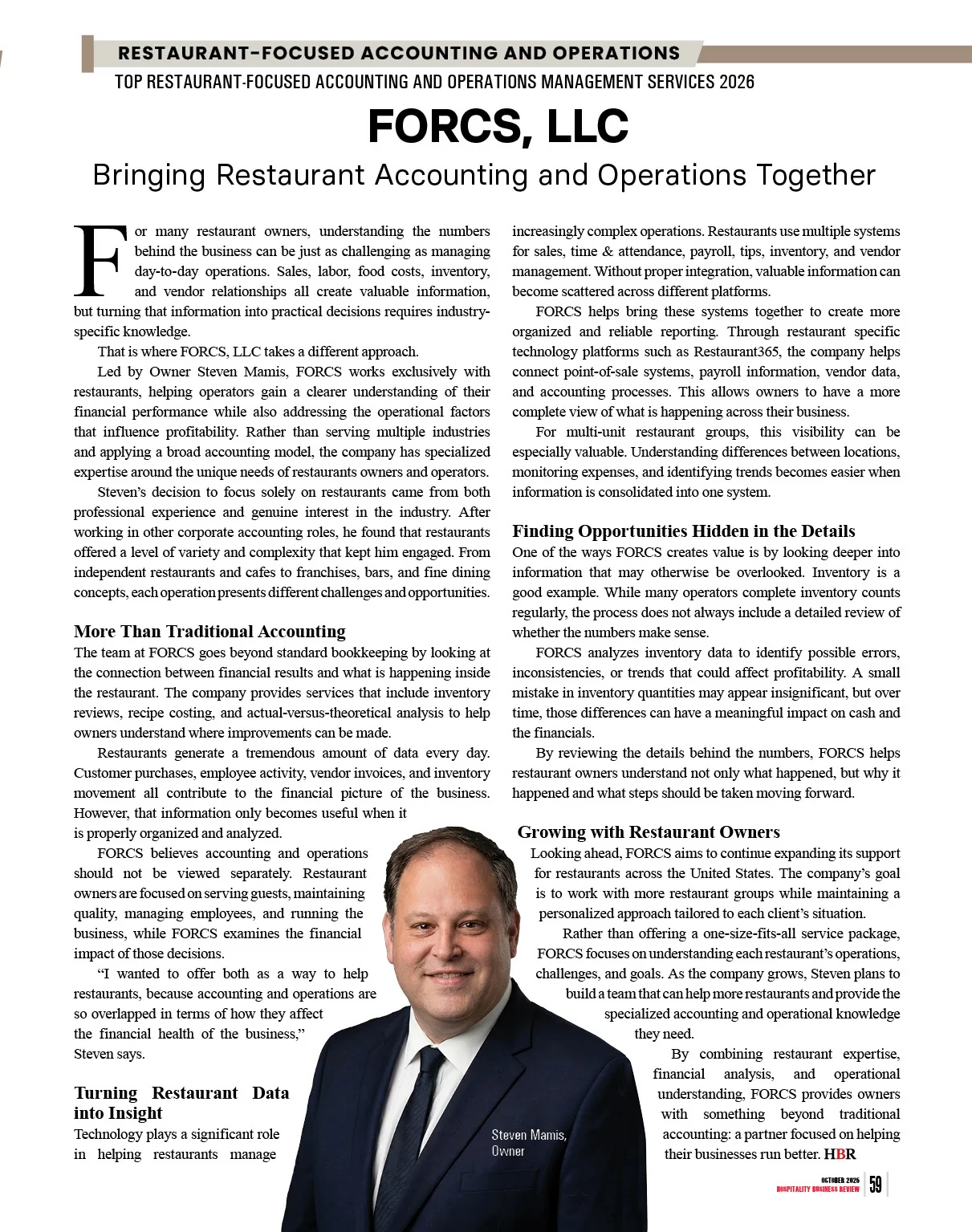
 Steven Mamis, Owner
For many restaurant owners, understanding the numbers behind the business can be just as challenging as managing day-to-day operations. Sales, labor, food costs, inventory, and vendor relationships all create valuable information, but turning that information into practical decisions requires industry-specific knowledge.
That is where FORCS, LLC takes a different approach.
Led by Owner Steven Mamis, FORCS works exclusively with restaurants, helping operators gain a clearer understanding of their financial performance while also addressing the operational factors that influence profitability. Rather than serving multiple industries and applying a broad accounting model, the company has specialized expertise around the unique needs of restaurants owners and operators.
Steven’s decision to focus solely on restaurants came from both professional experience and genuine interest in the industry. After working in other corporate accounting roles, he found that restaurants offered a level of variety and complexity that kept him engaged. From independent restaurants and cafes to franchises, bars, and fine dining concepts, each operation presents different challenges and opportunities.
More Than Traditional Accounting
The team at FORCS goes beyond standard bookkeeping by looking at the connection between financial results and what is happening inside the restaurant. The company provides services that include inventory reviews, recipe costing, and actual-versus-theoretical analysis to help owners understand where improvements can be made.
Restaurants generate a tremendous amount of data every day. Customer purchases, employee activity, vendor invoices, and inventory movement all contribute to the financial picture of the business. However, that information only becomes useful when it is properly organized and analyzed.
FORCS believes accounting and operations should not be viewed separately. Restaurant owners are focused on serving guests, maintaining quality, managing employees, and running the business, while FORCS examines the financial impact of those decisions.
“I wanted to offer both as a way to help restaurants, because accounting and operations are so overlapped in terms of how they affect the financial health of the business,” Steven says.
Turning Restaurant Data into Insight
Technology plays a significant role in helping restaurants manage increasingly complex operations. Restaurants use multiple systems for sales, time & attendance, payroll, tips, inventory, and vendor management. Without proper integration, valuable information can become scattered across different platforms.
-
I wanted to offer both as a way to help restaurants because accounting and operations are so overlapped in terms of how they affect the financial health of the business.
FORCS helps bring these systems together to create more organized and reliable reporting. Through restaurant specific technology platforms such as Restaurant365, the company helps connect point-of-sale systems, payroll information, vendor data, and accounting processes. This allows owners to have a more complete view of what is happening across their business.
For multi-unit restaurant groups, this visibility can be especially valuable. Understanding differences between locations, monitoring expenses, and identifying trends becomes easier when information is consolidated into one system.
Finding Opportunities Hidden in the Details
One of the ways FORCS creates value is by looking deeper into information that may otherwise be overlooked. Inventory is a good example. While many operators complete inventory counts regularly, the process does not always include a detailed review of whether the numbers make sense.
FORCS analyzes inventory data to identify possible errors, inconsistencies, or trends that could affect profitability. A small mistake in inventory quantities may appear insignificant, but over time, those differences can have a meaningful impact on cash and the financials.
By reviewing the details behind the numbers, FORCS helps restaurant owners understand not only what happened, but why it happened and what steps should be taken moving forward.
Growing with Restaurant Owners
Looking ahead, FORCS aims to continue expanding its support for restaurants across the United States. The company’s goal is to work with more restaurant groups while maintaining a personalized approach tailored to each client’s situation.
Rather than offering a one-size-fits-all service package, FORCS focuses on understanding each restaurant’s operations, challenges, and goals. As the company grows, Steven plans to build a team that can help more restaurants and provide the specialized accounting and operational knowledge they need.
By combining restaurant expertise, financial analysis, and operational understanding, FORCS provides owners with something beyond traditional accounting: a partner focused on helping their businesses run better.
Accounting That Connects the Books to the Kitchen
Restaurants rarely lose financial clarity in one dramatic break. More often, the numbers drift because sales data arrives from the point-of-sale system, payroll lives elsewhere, vendor invoices move through another workflow and bank feeds add another source of records. A monthly profit-and-loss statement can still balance while underlying food cost or labor assumptions are wrong. For an executive comparing restaurant accounting and operations support, the real question is whether the service can trace those inconsistencies back to the activity that produced them.
Industry specialization matters because restaurant economics punish generic bookkeeping. Small errors in inventory counts can distort cost of goods sold, while menu changes can make prior recipe assumptions obsolete before month-end reporting catches up. An effective provider should understand how restaurant transactions behave and how location-level reporting changes for multi-unit groups. It should also recognize where accounting entries stop being enough. Depth in one industry shortens the distance between a financial anomaly and a plausible explanation, which makes management review more useful.
Data quality creates the next test. Restaurant groups may be feeding POS, payroll, inventory and bank data into different systems, and automation only helps when mappings remain accurate. A clean integration can reduce manual entry, but it cannot compensate for a misclassified item or a bad count. Buyers should look for a service model that treats system setup as ongoing financial work rather than a one-time technical project. That includes checking whether the chart of accounts still reflects how the business runs and whether location reporting remains comparable as concepts change.
The strongest accounting relationship also reaches far enough into restaurant activity to explain margin movement. Inventory review can expose a count that looks plausible in isolation but conflicts with purchases or prior periods. Recipe costing can show whether menu economics have shifted before a broad expense ratio signals trouble. The value lies in linking those findings back to the financial statements without turning the accountant into the restaurant manager. Executives need analysis that gives operators something specific to investigate, not a backward-looking report that merely confirms a variance.
“FORCS's restaurant-only focus keeps accounting analysis tied to the patterns that matter inside a restaurant rather than adapting a general bookkeeping model.”
Service fit should also reflect the restaurant group’s actual maturity. Some operators need disciplined bookkeeping and dependable closes. Others require deeper cost analysis because their unit count, menu complexity, reporting cadence or geographic spread has outgrown an accounting-only model. A capable provider should be able to support either condition without forcing every client into the same package. Flexibility matters most when the underlying method stays consistent enough for management to compare periods and locations without reinterpreting the numbers each time.
FORCS merits consideration as a premier choice for restaurant groups that want accounting work connected directly to restaurant activity. Its restaurant-only focus keeps accounting analysis tied to the patterns that matter inside a restaurant rather than adapting a general bookkeeping model. Its service scope combines restaurant accounting with operations support, including inventory review and recipe costing. FORCS also works inside Restaurant365 and QuickBooks Online, using item-level mapping to connect restaurant activity with cleaner financial reporting. That combination is most relevant for buyers who want one firm to examine both the books and the restaurant processes affecting them, especially where recurring data issues can otherwise pass into period-end reports unnoticed.
...Read more
Restaurant-Focused Accounting and Operations Management Services Info
Q1
What Are Restaurant-Focused Accounting and Operations Management Services?
Restaurant-Focused Accounting and Operations Management Services combine financial reporting with an understanding of the operational activity that produces those numbers. The scope can include bookkeeping, inventory review, recipe costing, actual-versus-theoretical analysis, payroll information, vendor data and reporting integration. The objective is to connect financial results with what is happening inside the restaurant, making it easier to identify cost movements, inconsistencies and operational factors affecting profitability.
Q2
How Does FORCS, LLC Approach Restaurant-Focused Accounting and Operations Management Services?
FORCS, LLC works exclusively with restaurants rather than applying a general accounting model across industries. Its approach connects accounting with restaurant operations, including inventory reviews, recipe costing and actual-versus-theoretical analysis. The company works with different restaurant formats, including independent restaurants, cafes, franchises, bars and fine dining concepts. This specialization allows its financial analysis to remain closely connected to the operating realities behind restaurant performance.
Q3
Why Is Industry-Specific Accounting Important for Restaurants?
Restaurant-Focused Accounting and Operations Management Services can help address financial issues that may not be apparent in conventional bookkeeping alone. Restaurant businesses generate information across sales, labor, food costs, inventory, vendors and other operating activities. A financial report can show a variance without explaining what caused it. Industry-specific analysis can connect that variance to inventory movement, recipe costs, purchasing activity or other restaurant processes, giving operators more useful information for investigation and management decisions.
Q4
What Technology Supports Restaurant-Focused Accounting and Operations Management Services?
Technology becomes particularly useful when restaurant information is spread across several systems. Restaurant-Focused Accounting and Operations Management Services can bring together point-of-sale, payroll, time and attendance, inventory, vendor and accounting information to create more consistent reporting. FORCS uses restaurant-specific platforms such as Restaurant365 to connect these data sources. Its work also includes Restaurant365 and QuickBooks Online, with item-level mapping used to connect restaurant activity with financial reporting.
Q5
How Can These Services Help Identify Hidden Restaurant Costs?
Restaurant-Focused Accounting and Operations Management Services can provide a closer examination of information that routine reporting may overlook. Inventory is one example. FORCS reviews inventory data for possible errors, inconsistencies and trends that could influence profitability. A discrepancy in quantities may appear minor when viewed individually, but repeated differences can affect cash and financial results over time. Recipe costing and actual-versus-theoretical analysis provide additional ways to examine whether operational activity aligns with financial expectations.
Q6
When Should a Restaurant Consider These Services?
Restaurant-Focused Accounting and Operations Management Services can become particularly relevant when an operation needs more than dependable bookkeeping and periodic financial statements. Growing restaurant groups may need clearer location-level reporting, consolidated information and deeper cost analysis as their operations become more complex. FORCS is structured around this connection between financial and operational information, with its restaurant-only focus and support for multi-unit visibility. The approach is intended to help owners understand not only what occurred financially, but also the operational factors behind those results.
